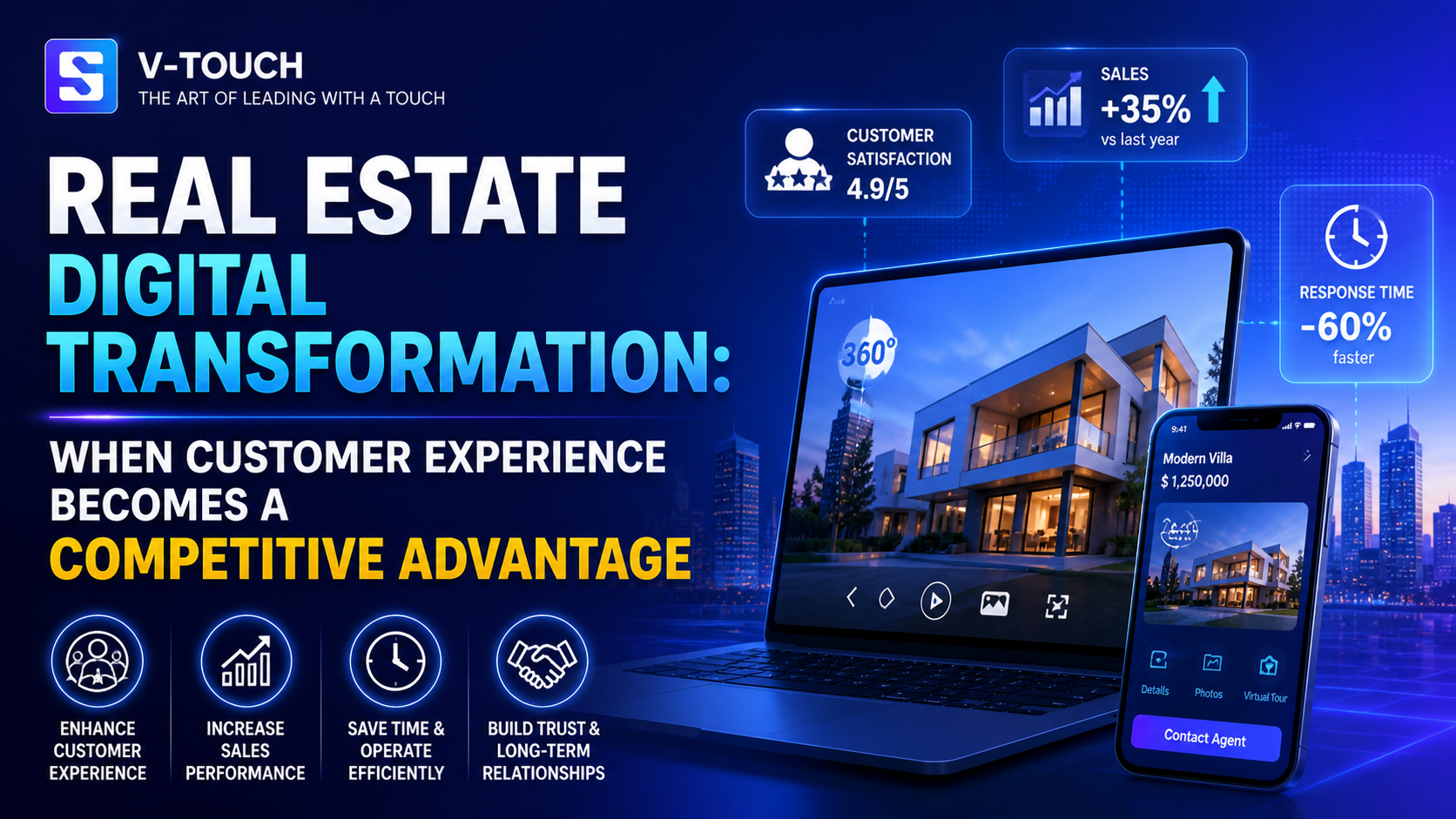
In a market with increasingly diverse supply, a customer’s decision is no longer driven entirely by the product. A beautiful apartment, a prime location, or a competitive price are now necessary conditions – but they are no longer sufficient.
The true differentiator today lies in the customer experience journey. This is why “real estate digital transformation” has evolved from a buzzword into the essential operating foundation for the entire industry.
1. The Paradox: Why Good Products Still Struggle to Sell
Many developers face a frustrating reality: their projects are well-invested, yet sales velocity fails to meet expectations. The sales cycle drags on, marketing costs skyrocket, and operations teams are bogged down by repetitive tasks.
If we look deeper, the problem isn’t the product; it’s how that product is “experienced.”
- Fragmented Journeys: Modern customers start online. If information is scattered or inconsistent, the emotional connection breaks.
- The Cost of Waiting: In real estate, interest is perishable. Every minute a customer spends waiting for a brochure or a callback is a minute their excitement cools.
- Lost Momentum: Losing interest often means losing a transaction entirely.
2. Digital Transformation is About People, Not Just Code
When people hear “digital transformation,” they often think of complex software or AI. However, the core of this movement is seamlessly redesigning the customer experience.
An effective digital system doesn’t just display data; it empowers customers to make decisions faster at the exact moment their engagement is highest. Platforms like V-Touch approach the market by changing how customers access and perceive value, rather than just changing the sales pitch.
From “Viewing Information” to “Experiencing Space”
The most visible shift is in project presentation. Static images and PDFs are being replaced by immersive 3D environments.
- Sensory Connection: Customers can virtually step into a unit, move freely, and observe the view.
- Shortened Imagination Gap: When a customer can “feel” the space, they spend less time trying to visualize it and more time deciding to buy it.
3. Speed: The Silent Closer
In the real estate journey, response time is an underrated deal-breaker. A customer browsing a project at midnight has an active emotional response. If they have to wait until 9:00 AM the next day for a response, that “hot spot” may have already cooled.
By leveraging AI and automated consultation:
- Inquiries are answered instantly.
- The “emotional momentum” is maintained.
- Conversion rates increase naturally without the need for high-pressure sales tactics.
4. Invisible Operations: Scaling Without the Friction
Digital transformation also revolutionizes the “back end” – the parts the customer never sees but always feels.
In traditional models, resources are drained by manual unit updates, contract processing, and data entry. An automated system makes these operations “invisible.” When data is synchronized and processes are streamlined, your team can stop acting like clerks and start acting like strategic advisors.
5. Data-Driven Decisions vs. Intuition
The final piece of the puzzle is how businesses use data. It is no longer just for end-of-month reports; it is a strategic guidance tool.
- Behavioral Tracking: Identify exactly where customers stop scrolling or what features they compare most.
- Optimized Campaigns: Use real-time feedback to tweak marketing spend.
- Product Evolution: Use data to design future projects that align perfectly with what the market actually wants.
Conclusion: Are You Selling a Product or an Experience?
Digital transformation doesn’t change the core value of your real estate project—it changes how that value is communicated and felt. In a crowded market, the business that controls the experience is the business that controls the sales speed.
The question for every developer today is simple:
Are your customers merely “buying” a product – or are they “experiencing” a new way of living?